
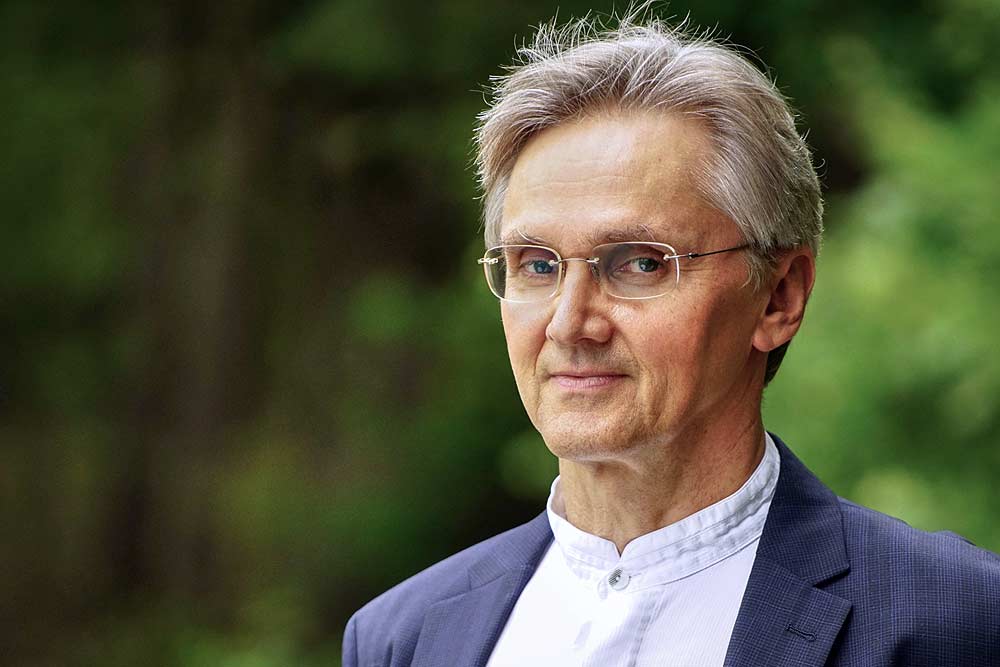
Prof. Frank Hill
Two guitars by Angela Waltner from 2015 – one with spruce top and the second with cedar top – surprised me very much. Both have characteristics that guitars should have had in this clarity for a long time. Spruce tops, in my opinion, have always offered the more beautiful tonal dynamic richness. Thus, the instrument with spruce top is theme.
Credit: Edgar Hill
On all known string, wind, or keyboard instruments, volume and timbre form a natural common catalog. In low registers they tend to softness and less intensity, in high registers they become more agile and intense, up to penetrating brightness. All these instruments, at least in the master class, have a construction that has long guaranteed the smooth transition between the two poles. Not so with the guitar. We know as one of our best-known annoyances that even in master guitars above the 12th fret the sound does not experience the increase in intensity as in the above mentioned instruments, but rather loses it – in many cases even significantly. The way the fingerboard is connected to the top can be limiting. The player has to use unnatural force without getting the adequate result – also psychologically a problem. Exceptions to this are, for example, guitars made by H. Hauser I, who is known to have performed some miracles 100 years ago. His instruments convert the energy even in the highest notes.
Now the guitar of Angela Waltner astonishes massively in several aspects. The instrument has neither double backs nor tops or appears visibly tricky innovative in its construction. Nevertheless, its sound power is extraordinary. For a normal volume, a third of the maximum of this guitar is quite sufficient. Thus, the small amount of power in the output volume leads completely naturally to a strongly malleable output sound. This fills a chamber hall without a care. At the same time, it gives an unknown amount of dynamic range upwards. It is a joy to have the possibility with 2/3 reserve to play a surprising forte in every register (!), which also has a corresponding increase in tonal intensity. The sensation also lies in the fact that on all strings the development from the 1st to the 20th fret takes place completely organically to the more intense – the higher, the more radiant. Even as a player, you can clearly feel how the attack energy is converted into sound without the slightest break all the way to the highest note. Angela Waltner has clearly succeeded in giving the overall energetic concept of the guitar the same perfection that we know from today’s orchestral instruments. A very significant and previously unknown step!
The many “subordinate” criteria, such as balance of registers, response of timbres, ease of bindings, etc., meet the highest standards, which, fortunately for us, is not an exception in guitar making today. Much rarer is the fact that more active vibrating areas, as in instruments made by H. Hauser I, move on the top and create life in the sound. Even empty strings sound alive with this remarkable effect, and can be integrated into phrases in a perfectly organic way. It is recommended to make a direct sound comparison between AW’s guitar and HH I’s guitar. Tradition is recognizable, with fundamentally differing characters. My greatest compliment is: both stand strong and confidently side by side.
Zühlsdorf b. Berlin April 2016